Not sure which product or specification is right for your application?
Request a complimentary sample — specify your material, equipment, and requirements. Ships within 2 business days.
Request Free Sample →
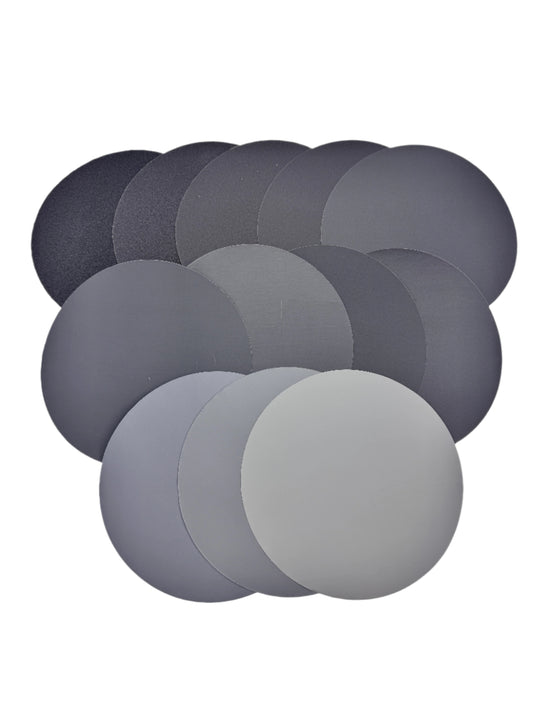
Beta Diamond Products silicon carbide (SiC) grinding papers provide consistent, reproducible material removal across all stages of metallographic specimen preparation. Available in PSA (pressure-sensitive adhesive) and plain-back formats in grit sizes from 60 through 4000, compatible with all 8-inch (200mm), 10-inch (250mm), and 12-inch (300mm) grinder-polisher platens, our papers are engineered for flat, uniform abrasive coatings and consistent cut rate throughout the full life of the paper.
Grit Sequences for Common Metallographic Materials
| Material Class |
Starting Grit |
Full Grit Sequence |
Transition to Diamond |
| Aluminum alloys, copper, soft brass |
320–400 |
320 → 600 → 1200 → 2400 → 4000 |
6μm or 3μm poly diamond |
| Annealed carbon & low-alloy steels |
180–240 |
180 → 320 → 600 → 1200 |
9μm diamond |
| Medium-hard steels (HRC 30–50) |
120–180 |
120 → 240 → 320 → 600 → 1200 |
9μm diamond |
| Hard steels, Ni superalloys (HRC 50+) |
80–120 |
80 → 120 → 240 → 320 → 600 |
9μm diamond disc |
| Titanium alloys (Ti-6Al-4V, CP-Ti) |
240 |
240 → 400 → 600 → 1200 |
9μm poly diamond |
| Cast iron |
120–180 |
120 → 240 → 320 → 600 → 1200 |
9μm diamond |
| Rock / geological specimens |
120–180 |
120 → 240 → 400 → 600 |
9μm or 3μm diamond (polished sections) |
| Ceramics, WC-Co carbides |
Bypass SiC papers — begin with 15μm or 9μm diamond grinding disc |
Each grit step must completely eliminate the scratch pattern from the previous step before advancing. Verify at 50–100× reflected light magnification between steps.
PSA vs. Plain-Back: Which Format to Use
PSA (pressure-sensitive adhesive) papers adhere directly to the platen surface with no additional accessories. This is the standard format for high-throughput labs. Single-use; cannot be repositioned after adhesion.
Plain-back papers require a separate adhesive disc, magnetic backing system, or water-adhesion onto glass. Preferred when papers need repositioning, when using non-standard platens, or when performing manual hand-lapping on flat glass or cast-iron plates.
Important: When to Use Zirconia or Diamond Grinding Instead of SiC
Silicon carbide grinding paper is the appropriate choice for most materials up to approximately HRC 60 (HV 700). For harder materials — cemented carbides (HV 1000+), technical ceramics, silicon carbide, boron carbide — SiC papers wear too quickly and produce excessive relief. For these materials, diamond grinding discs or zirconia abrasive papers are more efficient and produce less surface damage. Contact Beta Diamond if you are unsure whether SiC or an alternative grinding medium is more appropriate for your material.
Need a grit sequence recommendation for your specific material?Our application team will advise on the correct sequence, starting grit, and paper format for your material and equipment. Request a free sample →
Frequently Asked Questions
What SiC grit sequence should I use for metallographic sample preparation of steel?
For medium-hard steels (HRC 30–50, HV 300–550): start at 120 grit and progress through 120 → 240 → 320 → 600 → 1200 grit SiC paper, then transition to 9 micron diamond polishing. For hard steels and nickel superalloys (HRC 50+, HV 550+): start at 80 grit and use 80 → 120 → 240 → 320 → 600, then transition to a 9 micron diamond grinding disc. Each step must completely remove the scratch pattern from the previous step — verify at 50–100× magnification before advancing to the next grit.
What is the difference between PSA and plain-back silicon carbide grinding paper?
PSA papers adhere directly to the platen with a factory-applied adhesive — no additional backing required, making them the standard choice in high-throughput labs. Plain-back papers require either a PSA adhesive disc, a magnetic backing system, or water adhesion. Plain-back papers are preferred when the same paper needs to be repositioned, when using a platen material incompatible with PSA adhesive, or for manual hand-lapping on glass or cast iron plates.
How often should I change SiC grinding paper?
Change SiC paper when it shows visible loading (clogging of the abrasive surface with material debris) or when the cut rate has noticeably decreased. For reproducible QC and research results, single-use grinding paper — one sheet per sample per step — is the standard practice and the only method that fully eliminates cross-contamination between samples.